
Rutherford County Criminal Court Cases
Rutherford County divides criminal work by court level. Circuit Criminal Court hears felonies and misdemeanors presented to the grand jury. General Sessions Criminal Court handles traffic matters, misdemeanors, and preliminary proceedings in felony cases. A preliminary hearing tests whether a felony accusation should move forward. It is not a final trial. Both county divisions work through the Rutherford County Judicial Center, and the elected Circuit Court Clerk keeps their dockets, pleadings, judgments, costs, and dispositions.
Municipal citations can take another route. Murfreesboro ordinance and traffic cases remain with Murfreesboro City Court, while Smyrna and La Vergne use their own city court channels. The issuing agency on the citation is therefore a useful first clue. A city citation does not become a General Sessions file just because the event occurred in Rutherford County. Conversely, a sheriff or Tennessee Highway Patrol citation may belong at the county clerk rather than the nearby city counter.
Rutherford County Court Routes
The court name controls where a reader searches, pays, or requests a certified result. The official Circuit Criminal page describes the felony and grand-jury docket. Its published view also shows the division's local rules and contact details. That distinction prevents a common error: asking the jail or a city clerk for a Rutherford County criminal judgment.
The county's Circuit Criminal image below comes from that official court page.
It connects Rutherford County case searches to the division that preserves felony pleadings and final judgments.
| Court | Typical work | Contact |
|---|---|---|
| Circuit Criminal | Felonies and grand-jury misdemeanors | 116 W. Lytle St., Room 102 615-898-7812 |
| General Sessions Criminal | Traffic, misdemeanors, felony preliminaries | 116 W. Lytle St. 615-898-7831 |
| Murfreesboro City Court | City ordinance and traffic citations | 111 W. Vine St. 615-890-2142 |
| Smyrna court channel | Smyrna citations | 615-355-5739 |
| La Vergne Municipal Court | City citations and ordinances | 5093 Murfreesboro Rd. 615-287-8630 |
Searching Rutherford County Case Records
Rutherford County launched its free Online Court Records System in July 2025. It replaced the former subscription logins and covers Circuit Court, General Sessions, and Clerk and Master data. The Rutherford County system is local, not a comprehensive Tennessee trial-court index. Start broad with a party name, then use the year, court, and criminal case type to reduce unrelated results.
- Open the local portal and accept its terms of use.
- Enter the party name. Select “Match all search terms” when the name produces too many results.
- Add a four-digit case year or the local case number when either is known.
- Select Circuit Court or General Sessions, then choose Criminal as the case type.
- Open the result, note its case number and status, and ask the correct clerk for copies or a certified disposition.
The search controls below work together. A known case number is the narrowest route, while a name and year help when the number is missing.
| Field label | Type | Required | Notes |
|---|---|---|---|
| Party Name | Text | Unspecified | Searches names in the local index |
| Match all search terms | Checkbox | No | Tightens name matching |
| Case Year | Text | No | Use a four-digit year |
| Case Number | Text | No | Best when the local number is known |
| Court Type | Checkbox list | No | Circuit, General Sessions, or Clerk and Master |
| Case Type | Checkbox list | No | Select Criminal rather than Civil |
Record the case number before leaving the portal. It is the most reliable key when requesting a Rutherford County copy or checking a later docket event.
Rutherford County Free Docket Portal
The 2025 change matters because public name and case-number searching no longer depends on an old paid subscription. Still, a screen result is an index, not a promise that every underlying paper or image is available for download. A result may identify the party, case style, number, year, court, type, and status. Detail can add charges, dates, events, hearings, and a disposition once the clerk enters it.
Rutherford County also maintains an official docket index for date- and judge-based calendars. Its notice says the posted dockets are informational, can change, and omit sealed cases. The manifest image below records that official warning and calendar route.
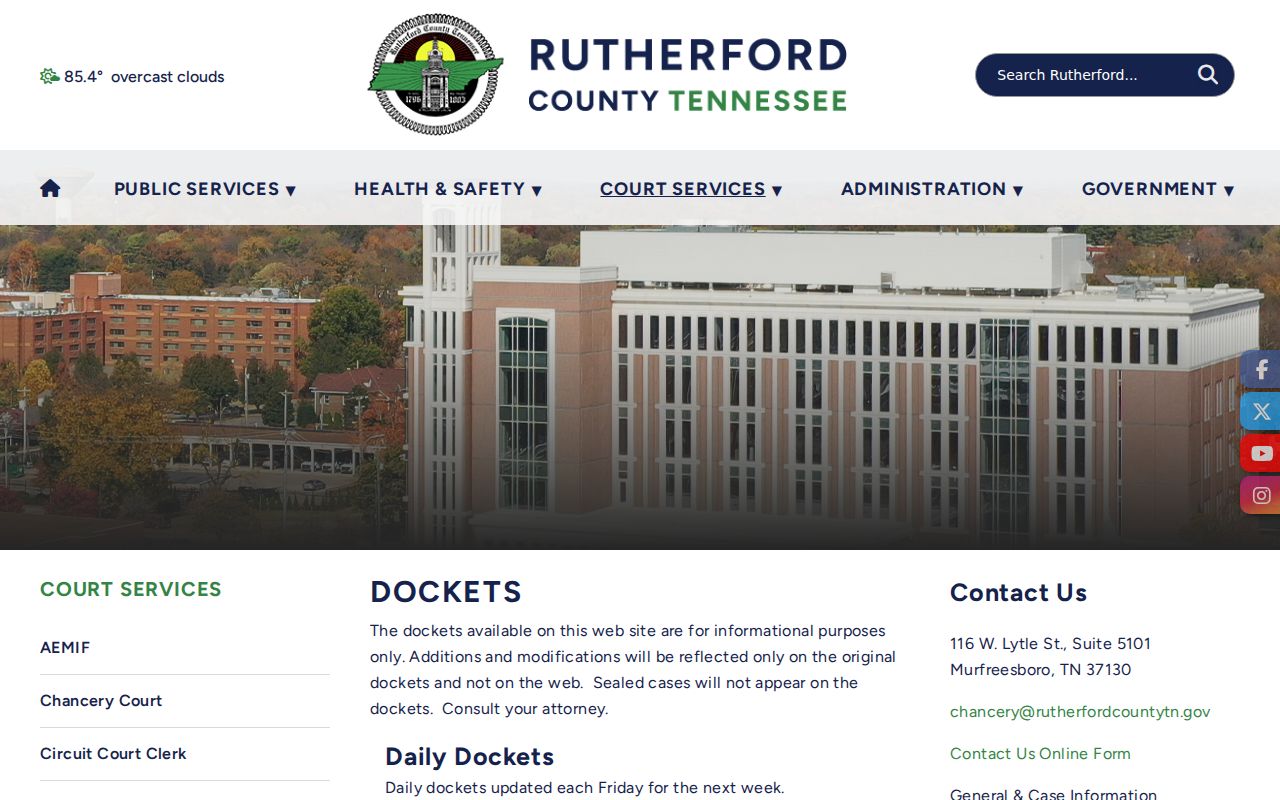
The docket helps confirm when a matter is set, but the clerk file remains the source for a final, certified court outcome.
Note: A missing calendar entry does not prove that Rutherford County has no case for the searched name.
Inside a Rutherford County Case File
A criminal case file follows one prosecution. It does not compile every event linked to a person. The charging document states what the state filed, while docket entries form the case's dated event list. Motions, hearing records, pleas, trial results, judgments, and financial assessments may appear as the matter develops. This makes the file the best place to tell an arrest allegation from the charge the prosecutor pursued and the result the judge entered.
| Case Number and Court | Identifies the local file and the Rutherford County division that owns it. |
|---|---|
| Charging Document | May be a complaint, information, presentment, or indictment stating the filed counts. |
| Docket Entries | Chronological notices, filings, settings, orders, and other case events. |
| Hearing Dates | Scheduled or completed arraignments, motions, preliminary hearings, pleas, and trials. |
| Disposition and Judgment | Shows how each charge ended, including conviction, dismissal, acquittal, or another entered outcome. |
| Sentence and Conditions | Lists the court-ordered result, such as confinement, supervision, costs, or restitution where imposed. |
“Disposition” means the recorded outcome of a charge. “Nolle prosequi” means the prosecutor formally chose not to continue it at that time. An acquittal is a not-guilty decision, while dismissal ends a count without a conviction. Those terms should be read count by count because one Rutherford County case can end with different outcomes for separate charges.
Certified Rutherford County Dispositions
A certified disposition is the clerk-authenticated record of how a Rutherford County case ended. It carries more weight than a screenshot of an online result when a reader is reviewing their own history, resolving an old entry, or documenting a dismissal. Ask the clerk for the disposition by party name, approximate filing or arrest date, case number if known, and court division. Older or non-indexed material may require a counter search.
The Circuit Court Clerk's policy says inspection is free. Letter- or legal-size black-and-white copies cost $0.50 per page, labor may be charged after one hour, and advance payment may be required when the estimate exceeds $20. The image below comes from the official clerk forms page, which also provides the public-record request and expungement forms.
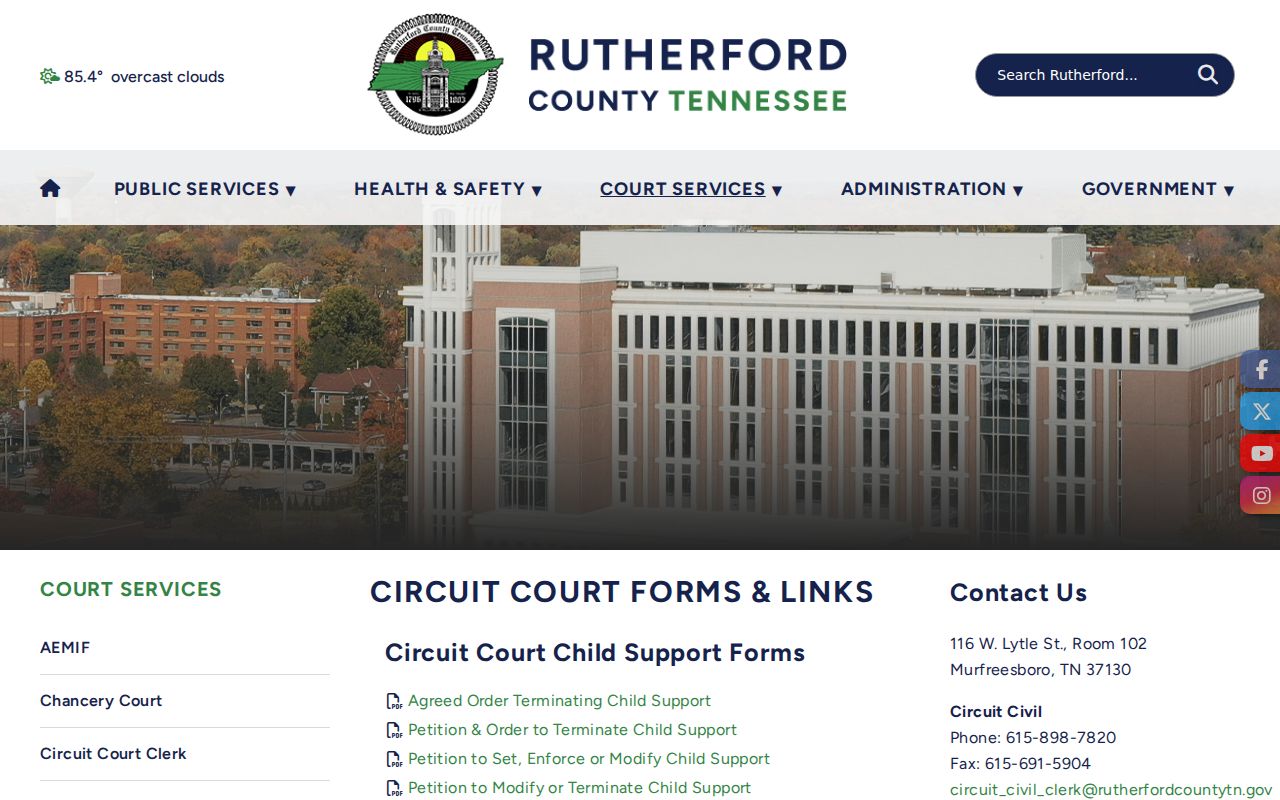
That forms route links the case file to copy requests and to later relief when a Rutherford County outcome is eligible for expungement.
How a Criminal Case Moves
The precise route depends on the charge. A judicial commissioner handles the early probable-cause and bond stage after many custodial arrests. General Sessions may try a misdemeanor or conduct a felony preliminary hearing. A felony bound over or presented to the grand jury moves into Circuit Criminal Court. The grand jury may return a “true bill,” meaning an indictment, or a “no true bill,” meaning it declined to indict the accusation presented.
Case flow: Charges Filed › Arraignment › Pretrial › Plea or Trial › Disposition › Sentencing
Arraignment is the hearing where the accusation is stated and a plea is entered. Rutherford County pretrial work can include motions, evidence issues, negotiation, and scheduled hearings. A plea or verdict does not end the record trail. The clerk must still enter the judgment, sentence, costs, and later orders. Courts then report dispositions to the Tennessee Bureau of Investigation so a fingerprint-supported arrest cycle can show its outcome.
Rutherford County Preliminary Dockets
General Sessions is often the first court file for a serious allegation, but it may not be the last. A felony can begin there, then receive a new Circuit Criminal path after bind-over or grand-jury action. Search both divisions when an early General Sessions result seems incomplete. The official General Sessions page supplies local contacts and payment information.
This manifest image captures the Rutherford County General Sessions information route.
It helps readers separate the preliminary and misdemeanor docket from the felony file kept by Circuit Criminal.
Payment rules also expose routing mistakes. General Sessions accepts local checks, money orders, cashier or certified checks, cash, and credit cards, but it does not accept an out-of-state personal check for an outstanding traffic ticket. A certified clearance letter after a suspended-license matter is listed at $5. Murfreesboro and Smyrna citations use their city channels instead of this county payment desk.
Rutherford County Specialty Case Dockets
Recovery or Drug Court, DUI Court, Mental Health Court, Veterans Court, and the Re-Entry Program are named Rutherford County court-supervision programs. They are not separate criminal-history databases. Orders, compliance events, and outcomes remain connected to the underlying court case. Searching only a program name can therefore miss the case number that ties the activity together.
This point is useful when a standard docket shows an unfamiliar supervision entry. Recovery Court is a treatment-focused program, yet the public record still belongs to the court division and clerk that handle the prosecution. A reader should use the case number to follow later orders and ask the clerk which portions are public. Program participation does not by itself define the final disposition.
Case Record Access & Restrictions
Tennessee court records are generally open, but access is not absolute. Rutherford County's Tennessee Public Records Act policy implements inspection, identity, specificity, response, redaction, and fee rules. Tennessee Supreme Court Rule 34 separately governs court-record access and bulk court data. A custodian need not create a new report or compilation that the office does not keep.
Sealed cases do not appear in Rutherford County's published dockets or free search. Juvenile matters, protected victim information, personal identifiers, and confidential material may also be withheld or redacted. Online views can be narrower than the clerk's public paper file. When a known case does not appear, contact the division with the name, date range, and case number rather than assuming the matter never existed.
Note: Verify a Rutherford County result with the clerk before relying on an online status or calendar entry.